

Slovakia has long been struggling with a shortage of highly qualified professionals while at the same time facing a brain drain abroad. Companies and institutions therefore find themselves confronted with the question of how to remain competitive while also ensuring a sufficient workforce for key positions. One possible solution is greater openness to foreign labor and a better understanding of who is coming to Slovakia and in which professions they are finding employment.
That is why we present this data overview, which shows what the employment of foreigners in Slovakia looks like and what role they play across individual industries and regions.
Data from the Central Office of Labour, Social Affairs and Family from September 2025 and a survey by Košice IT Valley show that foreign workers play an important role in supplementing the workforce in areas where Slovak companies have long experienced labor shortages. The largest number of employees come from third countries, with a significant share made up of Ukrainian citizens.
In the article, we divide foreign workers into three groups: Ukrainians, citizens of other third countries, and citizens of EU and EEA countries (EEA – European Economic Area).
Where do foreigners work the most?
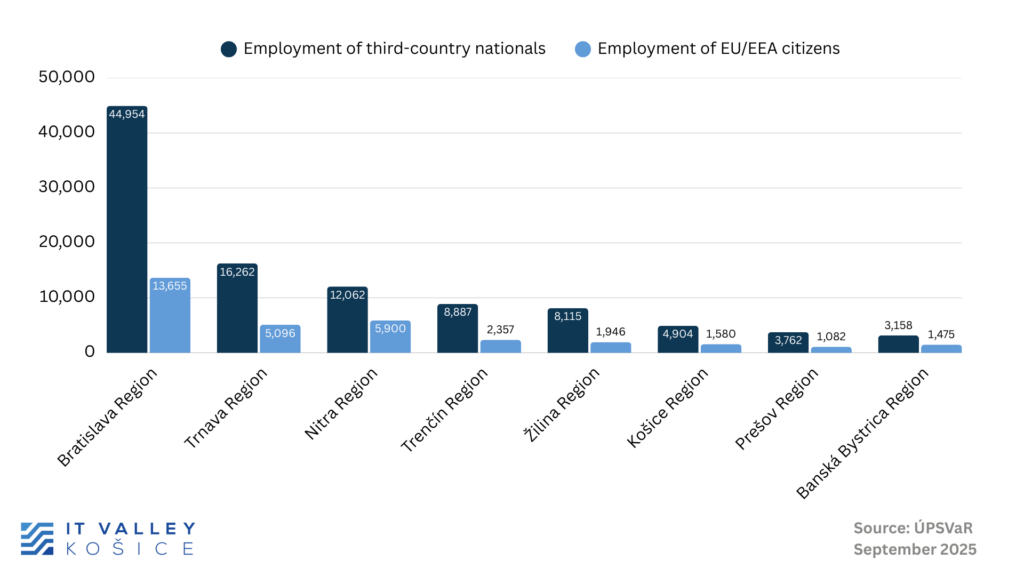
At first glance, it is clear that the Bratislava Region is the center of foreign employment in Slovakia. Nearly 45,000 third-country nationals and more than 13,000 EU/EEA citizens work there. The capital city and its surrounding areas have long attracted foreign workers due to the higher concentration of companies, better wages, and more developed services.
With a significant gap, the Trnava Region follows with approximately 16,000 third-country workers, the Nitra Region with more than 12,000, and the Trenčín Region, where nearly 9,000 foreigners are employed. These are regions with a strong presence of industry and manufacturing—sectors that have long relied on foreign labor.
At the opposite end of the ranking is the Banská Bystrica Region, where slightly more than 4,500 foreigners are employed, as well as the Košice and Prešov Regions, where the total number of employed foreigners reaches 11,328. Despite this, a growing trend is visible here as well, indicating that foreign workers are gradually finding employment opportunities beyond the largest economic centers.
The overall picture shown in the chart indicates that the employment of foreigners in Slovakia is strongly concentrated in the western part of the country, where there is higher demand for labor and a more developed business environment. In the east, this trend is developing more slowly so far, but there is clearly significant growth potential.
Which occupations do they work in?
Foreigners in Slovakia are employed across the full spectrum of occupations—from production lines to professional and managerial positions. The largest share work as plant and machine operators and assemblers, followed by elementary and low-skilled workers, service and sales workers, and skilled trades workers.
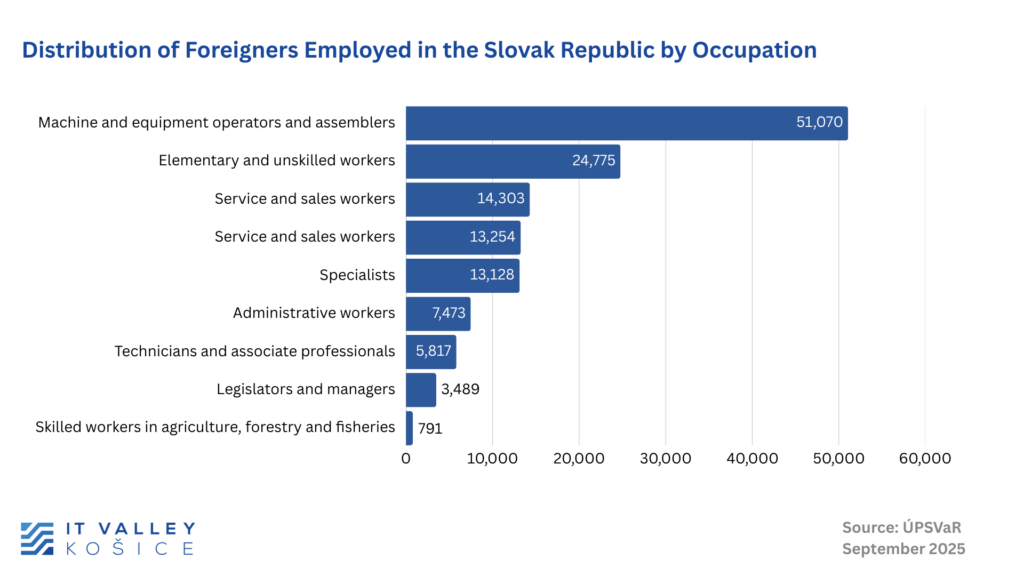
In addition to manual occupations, they are also represented in professional and administrative positions, working as specialists, technicians, and managers. This distribution shows that foreigners are employed across various sectors and contribute to different levels of the labor market—from operational roles to highly qualified professions.

Interestingly, despite the presence of thousands of foreign workers, a large number of job vacancies remain unfilled in Slovakia. Data from the Central Office of Labour, Social Affairs and Family (ÚPSVaR) show that demand for workers in manufacturing, services, and technical occupations continues to significantly exceed supply.
Foreigners in the Slovak labor market are employed across a wide range of occupations; however, the labor market still has the capacity to absorb additional workers, particularly in segments that require manual or technical skills.
Ukrainians mainly work in manual occupations
The chart shows that Ukrainians have the highest representation in manual occupations—particularly among elementary and low-skilled workers, service and sales workers, as well as in agriculture, forestry, and fisheries.
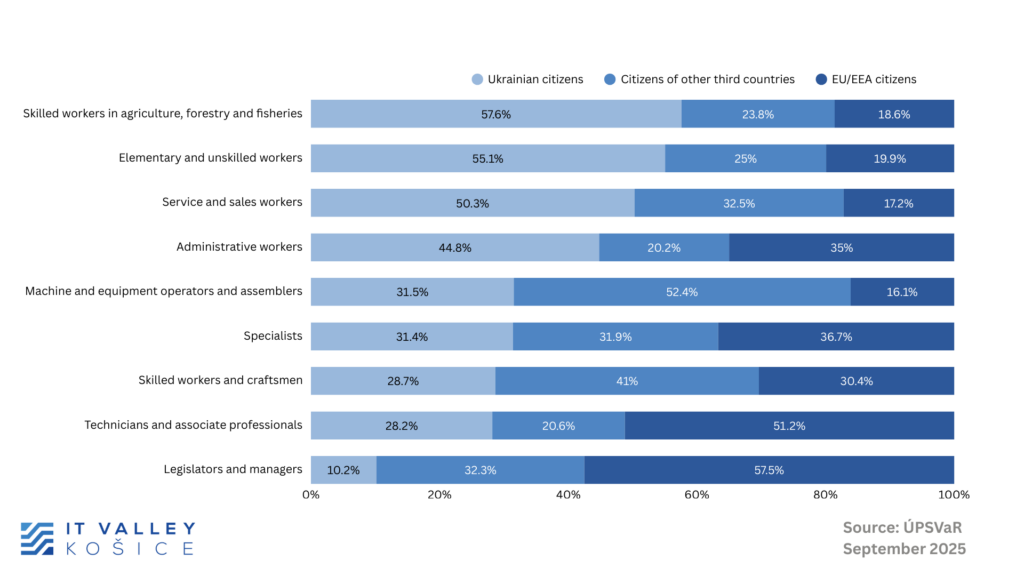
In contrast, citizens of other third countries are most strongly represented among plant and machine operators and assemblers, as well as among skilled workers and tradespeople. This group therefore tends to concentrate in industrial and technical occupations.
EU citizens are most frequently represented in professional and managerial positions—namely among specialists, technicians, and administrative or managerial staff. Their representation tends to increase with the level of qualification required for a given occupation.
Educational profile of foreigners
The chart highlights differences in the educational profile of foreigners by country of origin. Ukrainians are most strongly represented in the categories of secondary and vocational education, which corresponds to the occupations in which they are most commonly employed in Slovakia—such as manufacturing and services.
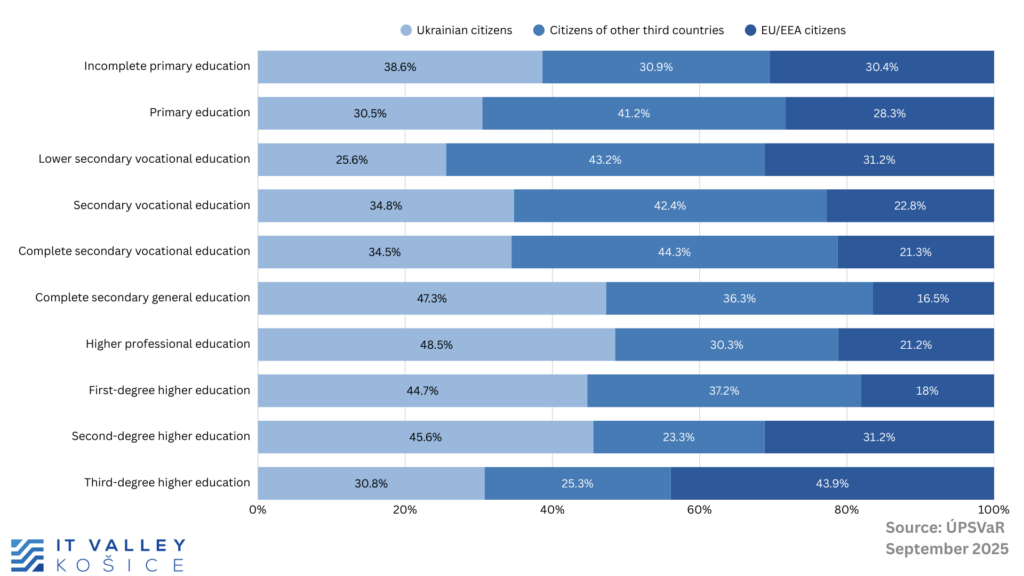
Citizens of other third countries have a relatively balanced distribution of educational attainment, but they are more prominently represented among those with lower secondary and full secondary vocational education.
In contrast, citizens of European Union countries are most numerous in the categories of second- and third-cycle higher education, indicating that they are primarily employed in more specialized and highly qualified positions.
Košice Region
If we look specifically at data for the Košice Region, we can see that the largest share of foreign workers consists of Ukrainian citizens (4,007). They are followed by citizens of the European Union (1,580), while a smaller group is made up of citizens of other third countries (897).
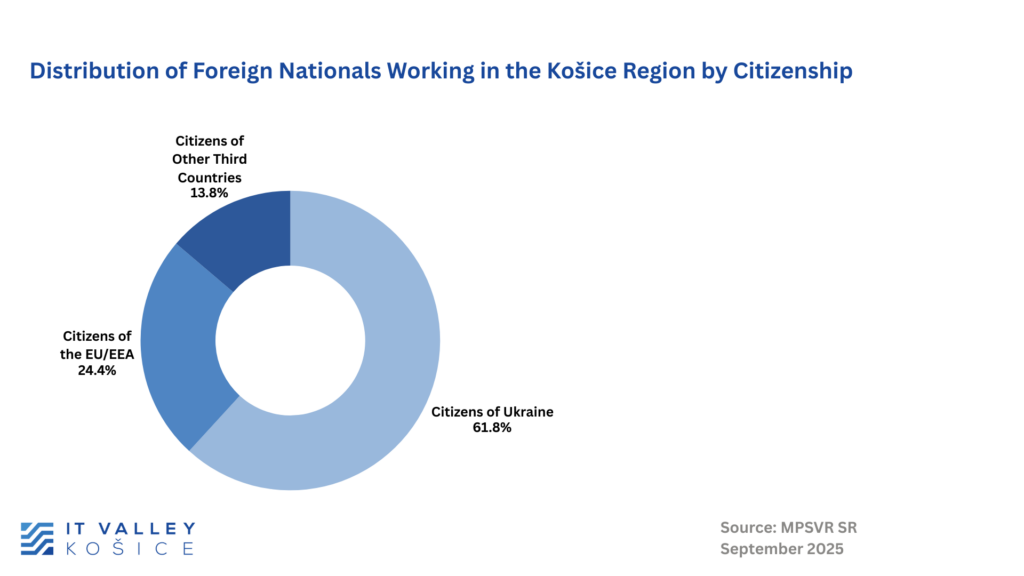
In the Košice Region, foreigners are employed across a wide range of occupations. The largest groups work as service and sales workers, plant and machine operators and assemblers, and elementary workers. Their representation is smaller in more specialized professions, such as among specialists, technicians, and administrative staff.
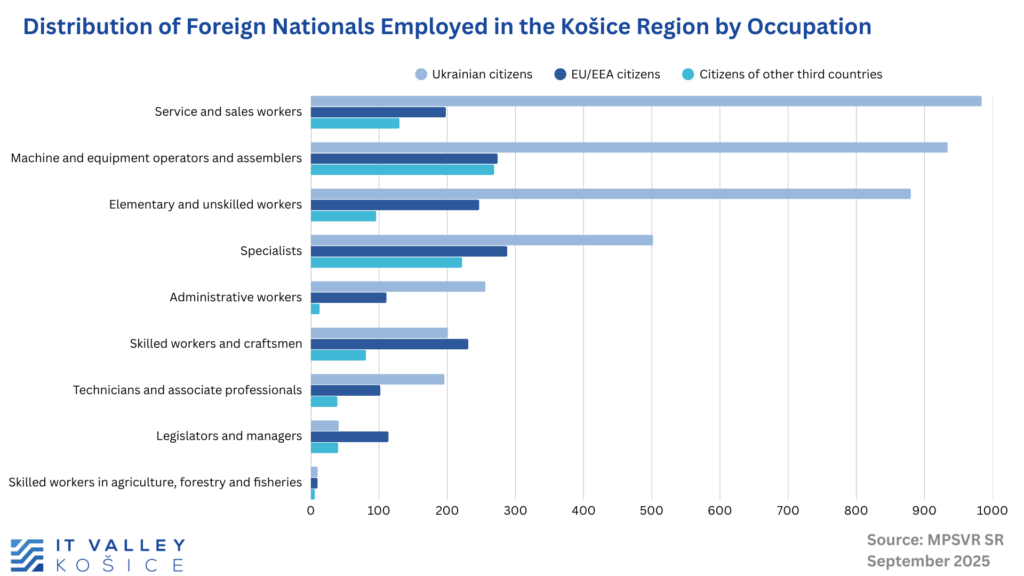
As part of the analysis, we present an overview of the distribution of foreigners in the Košice Region by occupation, showing the types of job positions in which different groups of foreign workers are most frequently represented.
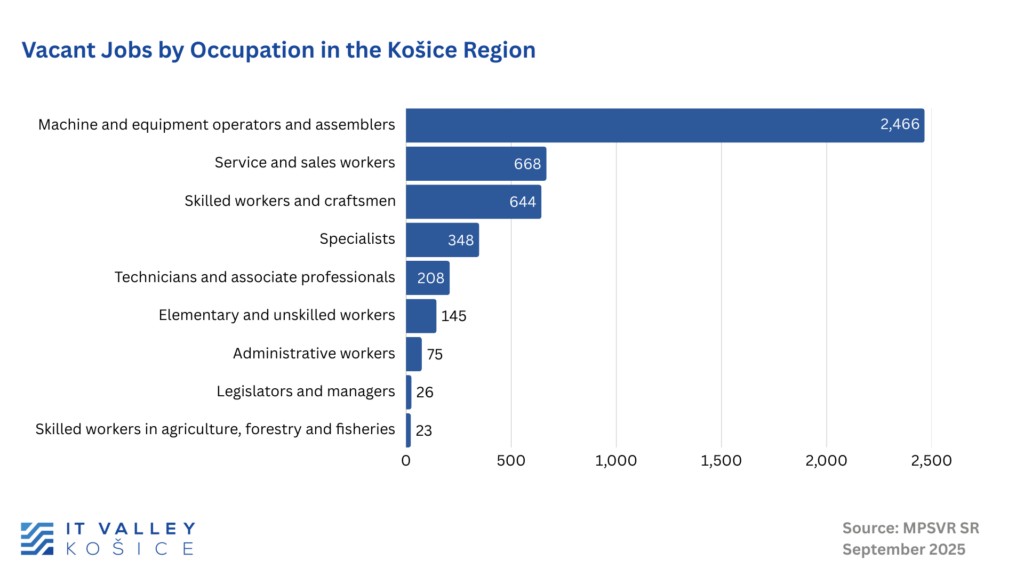
The situation in the Košice Region is similar to that of Slovakia as a whole—most job vacancies are in technical and operational occupations. The region also faces a relatively high shortage of specialists, i.e. positions that typically require a university degree.

The data reveal a very significant gap between the number of foreign students studying in Košice, the number who graduate, and the number who ultimately remain working in the region. While foreigners make up a substantial share of university students in Košice and still represent a noticeable proportion among graduates, their share among those employed with a university degree is practically minimal.
It is clear that a large share of foreign students leave Košice after completing their studies. Although they obtain their education here, they do not remain working in the region—whether they move to other regions of Slovakia, go abroad, or possibly do not enter the Slovak labor market at all.
The chart therefore points to a clear challenge: the region is not succeeding in retaining talent that is already present— even those who have spent their entire university studies here.
Košice IT Valley Survey
As part of a survey we conducted to map the experiences of Slovak employers with hiring third-country nationals, 20 companies participated, primarily operating in the field of information technology. Together, these companies employ 9,043 people, of whom 5.2% come from countries outside the European Union, with Ukrainian citizens representing the largest group.
The survey revealed that companies face several obstacles when employing third-country nationals. The most frequently mentioned issue is complex administration and legislation, which significantly complicate and prolong the process of obtaining work permits. Companies highlight the need to simplify, streamline, and accelerate the permit procedures—not only for employees, but also for students from third countries.
Another significant barrier is the insufficient support from the state and public institutions. Employers report a lack of better coordination between authorities and the absence of a central information point that would provide clear and up-to-date information on the possibilities and procedures for employing foreigners.
Companies also consider the language barrier to be a significant issue. This does not concern only the employees themselves, but also communication with public authorities, which are often unable to communicate effectively in English. A smaller share of respondents mentioned additional obstacles, such as insufficient qualifications and skills of some applicants, the risk of early departure after hiring, and cultural differences related to adaptation to the workplace environment.
As potential solutions, companies propose reducing the bureaucratic burden and harmonizing the legislation governing the employment of foreigners and international students. They also recommend improving the language accessibility of public offices so that administrative procedures can be handled in English. Several companies would welcome relocation allowances for families of employees from third countries, as well as the establishment of online information platforms that would simplify navigation through legislative and administrative processes.
The overall picture suggests that companies are interested in employing foreigners, but systemic and administrative barriers often hinder their efforts. Simplifying procedures, improving state support, and ensuring effective communication could therefore significantly contribute to the more successful integration of foreign workers into the Slovak labor market.
Sources:
Central Office of Labour, Social Affairs and Family (ÚPSVaR),
Centre for Scientific and Technical Information of the Slovak Republic (CVTI SR),
Ministry of Labour, Social Affairs and Family of the Slovak Republic – Department of Statistics, Data Analysis and Reporting (MPSVR SR),
Košice IT Valley Survey.
This publication is part of the outputs of the INVESTech project, which systematically focuses on the development of the ICT sector, the analysis of skills needs, and the modernization of education systems through the integration of innovation and new technologies.
For more information about the INVESTech project.
Last updated: December 2, 2025


